I brought this length of fabric home from a trip to Peru many years ago. It’s 45″ wide and 43″ long, and made most likely from alpaca wool.

I bought it in a huge open-air market in Cusco, the lovely town that is the jumping-off point for travelers visiting Machu Picchu. The market scene is one that has probably been unchanged for centuries, with all manner of things, including fresh produce, pottery, and textiles, laid out for shoppers to make their choices.
I bought it because I loved the colors and the complex woven design, but only recently did I realize how very interesting it is. This happened as a result of reading The Fabric of Civilization by Virginia Postrel. The book brings home what a significant achievement woven fabric represents, from growing and/or processing fibers like linen, cotton, and wool, though spinning, dying, and weaving, and it argues convincingly that civilization would not have developed as it did without these technologies.
Postrel’s discussion of handwoven Peruvian textiles includes a photo of an in-progress fabric featuring a pattern very similar to mine. Based on this discussion, I believe my fabric is a lliklla, a type of cape or cloak, also sometimes used by mothers to carry their babies on their backs.
In the photo in Postrel’s book, the fabric is being woven on a backstrap loom. Here’s link to some information about backstrap looms. Scroll down for a photo of a person using one; it shows clearly how the “backstrap” functions.
A completed lliklla is twice as wide as a backstrap loom, and it’s easy to see that mine is composed of two panels sewn together. Here’s a closeup of the seam down the middle.

It’s also easy to see that the panels were woven with the intention of stitching them together. Each is twenty-two and a half inches wide, and almost symmetrical but not quite. Notice that one edge (at the bottom, here) is finished with a red band and a narrow black border, but the other edge (at the top) omits the black border. When the two plain red bands are joined, they form a red stripe down the middle.

Each panel features a section of solid brown in the middle, bordered by wide stripes decorated with diamond shapes worked from red and gold yarn. A close look reveals a great deal of variety in the design of the diamonds and the half-diamonds or triangles that fill in along the edges. Here you can also see more clearly the differences between the two green stripes on each panel.The green stripe that bisects the diamonds in the stripe closest to the center is solid green and narrower, while the other green stripe is wider with a complicated pattern of its own.
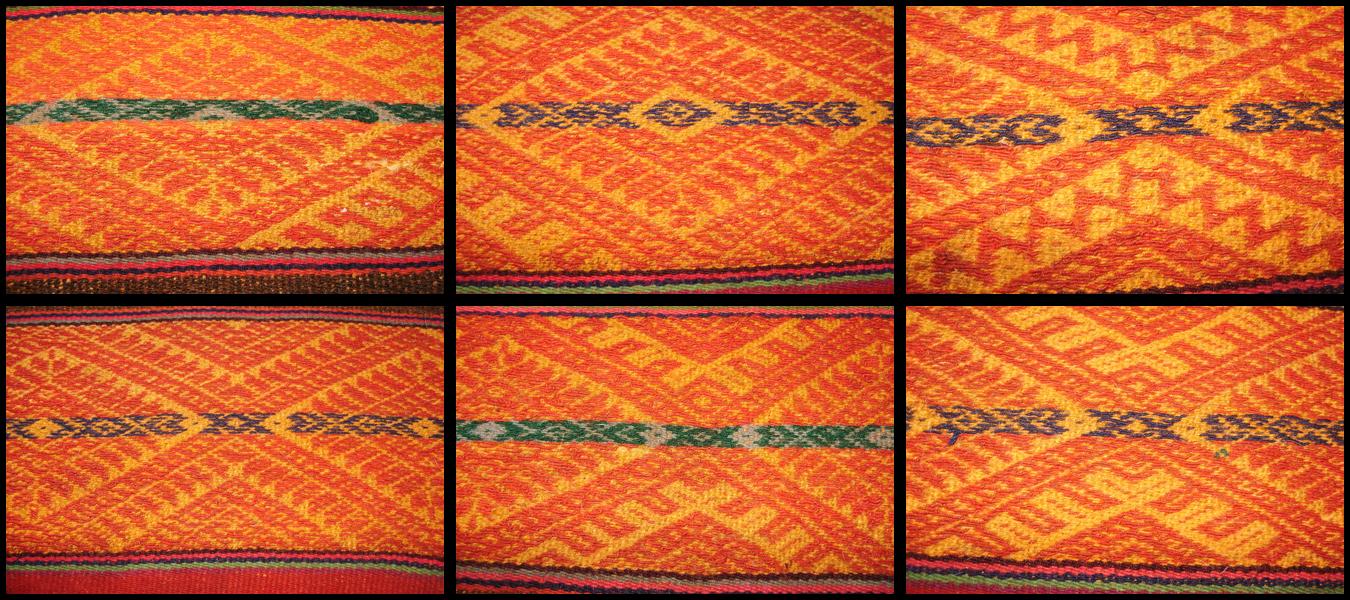
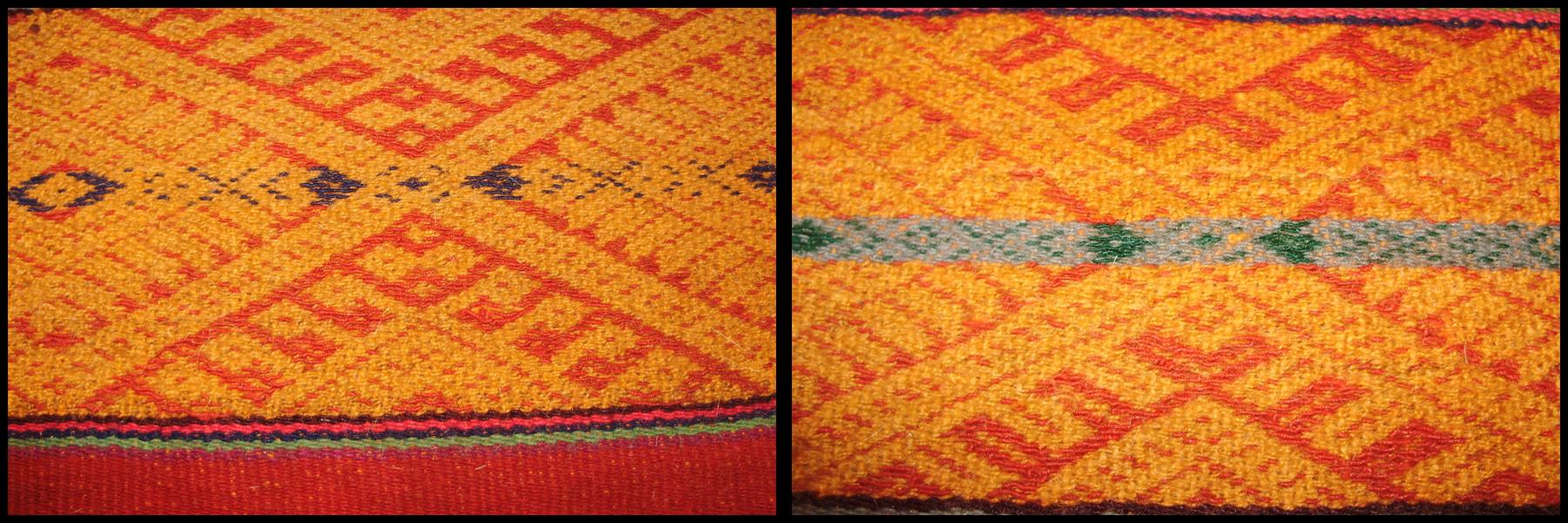
The reverse side of the lliklla is as interesting as the front, with gold where red appears on the front and vice versa. Here you can also see the reverse of the wide green stripe on the left and the reverse of the narrow green stripe on the right.
On the same trip my husband took a picture of a woman in the marketplace spinning wool with a drop spindle. She was the topic of an earlier Yarn Mania post, “Spindle Woman,” and I now see that she is wearing a lliklla, probably of her own creation.